Why Northern Michigan Sprinkler Systems Get Blown Out Every Fall
The fall blow-out is the one sprinkler visit you can't skip, and here is exactly why.
October 14, 2026 · 4 min read
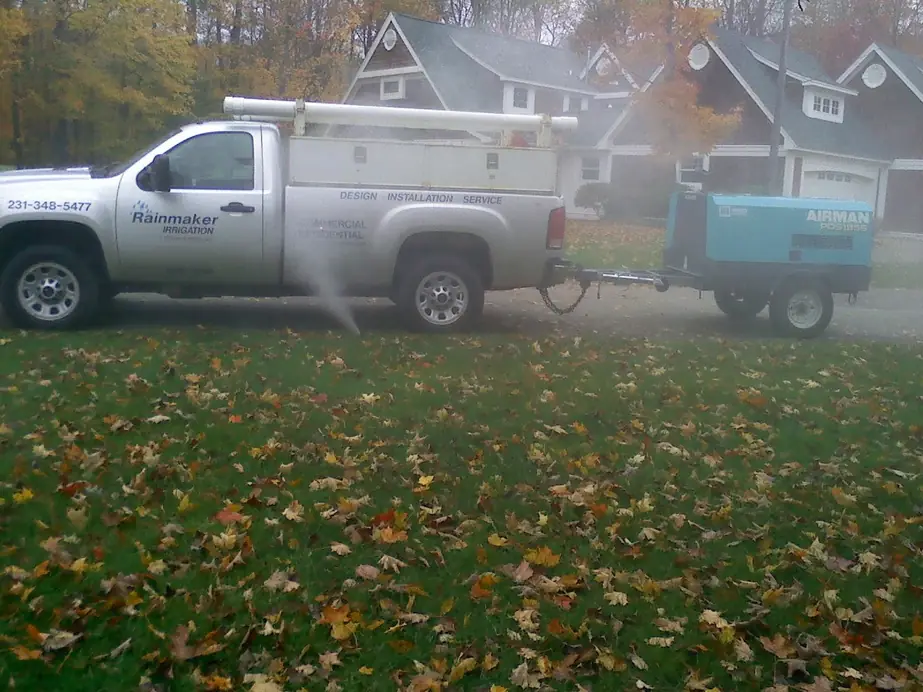
If you own a sprinkler system in Northern Michigan, the fall blow-out is the one job on the calendar you can't skip. Almost everything else about an irrigation system can be fixed after the fact. A freeze can crack a line, split a valve body or shatter a head, and you won't know until the system comes on in spring and water shows up where it shouldn't.
This post explains what actually happens inside a buried system when the ground freezes, what a compressed-air winterization does about it, and what to expect from the visit. It's general information, the kind any homeowner, condominium association or property manager should have before the leaves come down.
Why water left in the lines is the problem
Water expands when it freezes. A pipe full of water that turns to ice has nowhere for the extra volume to go, so the pressure pushes outward on the pipe wall, the fittings and whatever sits at the end of the line. PVC and poly pipe are strong, but they aren't built to be a mold for ice.
Sprinkler systems are full of low spots. Water settles in the bottom of valves, in elbows, in the body of each head and in any stretch of pipe that dips between two higher points. Gravity alone doesn't empty those places. A system can look dry at the head and still hold water in the valve box.
Northern Michigan makes this worse than most places. Our winters bring long stretches of deep cold, and frost can reach far into the ground. Lines near a driveway edge, a walkway or a foundation tend to see the hardest freeze, because there is pavement or masonry on one side pulling the cold in.
What a freeze actually damages
- Valve bodies and diaphragms, where water pools below the line and cracks the housing.
- The backflow preventer, the device that keeps irrigation water from flowing back into the drinking supply. It holds trapped water inside and often sits above ground, where the cold hits it directly.
- Pop-up heads and risers, which can split along the body or crack at the threads.
- Fittings and glued joints, which fail first because they are the weakest point in any line.
- The pipe itself, which can split lengthwise and leak for months before anyone notices.
Most of this shows up in spring, when the system is pressurized again. A split fitting under the lawn may not announce itself with a geyser. It might show as a soggy patch, a zone with weak pressure, or a water bill that creeps up through the summer.
What a compressed-air winterization is
A winterization, often called a blow-out, pushes the water out of the system with compressed air instead of waiting for it to drain on its own. A technician shuts off the water supply to the system, connects an air compressor to the line, and runs the zones one at a time. Air moves through the pipe and pushes water out of the heads until they spit mist instead of water.
Running one zone at a time matters. A compressor can only move so much air, and trying to clear everything at once leaves some zones with water behind. Working zone by zone lets the air do its job in each section of pipe, and the technician can watch which heads have cleared.
The compressor is also why this is a poor do-it-yourself job. Too much air can harm heads and fittings, and running air through a zone that has no flow can overheat plastic parts. Someone who blows out systems regularly knows when to stop and when to run a zone again.
Timing, and what to do if a freeze beats you
The practical rule is simple: winterize before the ground freezes, not after. Once a hard freeze sets in, any water left behind can already be turning to ice. Booking early also keeps you out of the rush when everyone calls during the same cold snap.
If a freeze arrives before your visit, shut off the water to the system at its supply valve and leave it off. That doesn't clear the lines, but it stops new water from entering them, and it tells whoever schedules you that the job is now urgent.
What to expect on the day
- Someone needs to be able to reach the system's shutoff and the backflow device, so clear any clutter in front of them.
- The technician shuts the water, connects the compressor and runs each zone in turn.
- You'll usually hear the heads cough and spit before they go dry.
- The controller is typically set to an off or rain mode so it doesn't try to run over the winter.
- Ask whether anything looked worn, since a blow-out is a good time to spot a cracked head.
How the fall visit fits a seasonal program
Rainmaker Irrigation has been locally owned and operated in Petoskey since 1987. Its seasonal maintenance program runs on three beats every year: a start-up in spring, monthly checks through the season and a winterization in the fall. The fall visit protects what the first two keep running. Skip it, and the spring start-up turns into a repair list.
The same logic applies at scale. Condominium complexes, commercial properties and athletic fields have more zones, which means more places for water to hide. To schedule a winterization or ask about a seasonal program, call (231) 348-5477. Estimates are free, and the office replies to contact-form requests by the next business day.
Rainmaker Irrigation, (231) 348-5477
Call (231) 348-5477More articles
What a Spring Sprinkler Start-Up Checks Before the First Watering
The first watering of the season is when a system tells you what winter did to it.
What a Monthly Sprinkler Check Catches During the Season
A sprinkler system is out of sight, so a problem can run for weeks before anyone sees it.